Why Early Language Apps Leave Children Silent: The Acoustic Foundation Young English Learners Actually Need
Parents across Seoul, São Paulo, and Madrid notice the same pattern: children tap correct answers on a tablet, yet freeze when spoken to in English. Here is how acoustic song, natural cadence, and story-driven rhythm help children ages 2 to 7 find their speaking voice.


You sit down at the kitchen table with your five-year-old in Bogotá, Tokyo, or Milan. You downloaded a popular English learning app because you want to give her an early head start with the language.
For twenty minutes, she matches colored tiles, pops floating balloons, and collects digital gold coins. Synthetic chimes ring out every time her index finger hits the screen.
Then you pause the tablet and ask a simple question in English: "Can you tell me what the rabbit was eating?"
She stares at the tabletop, tugs at the cuff of her sleeve, and says nothing.
She spent twenty minutes interacting with an English app, yet she did not produce a single spoken word. Her finger was busy, but her voice stayed quiet.
Why tapping on glass rarely translates into spoken English
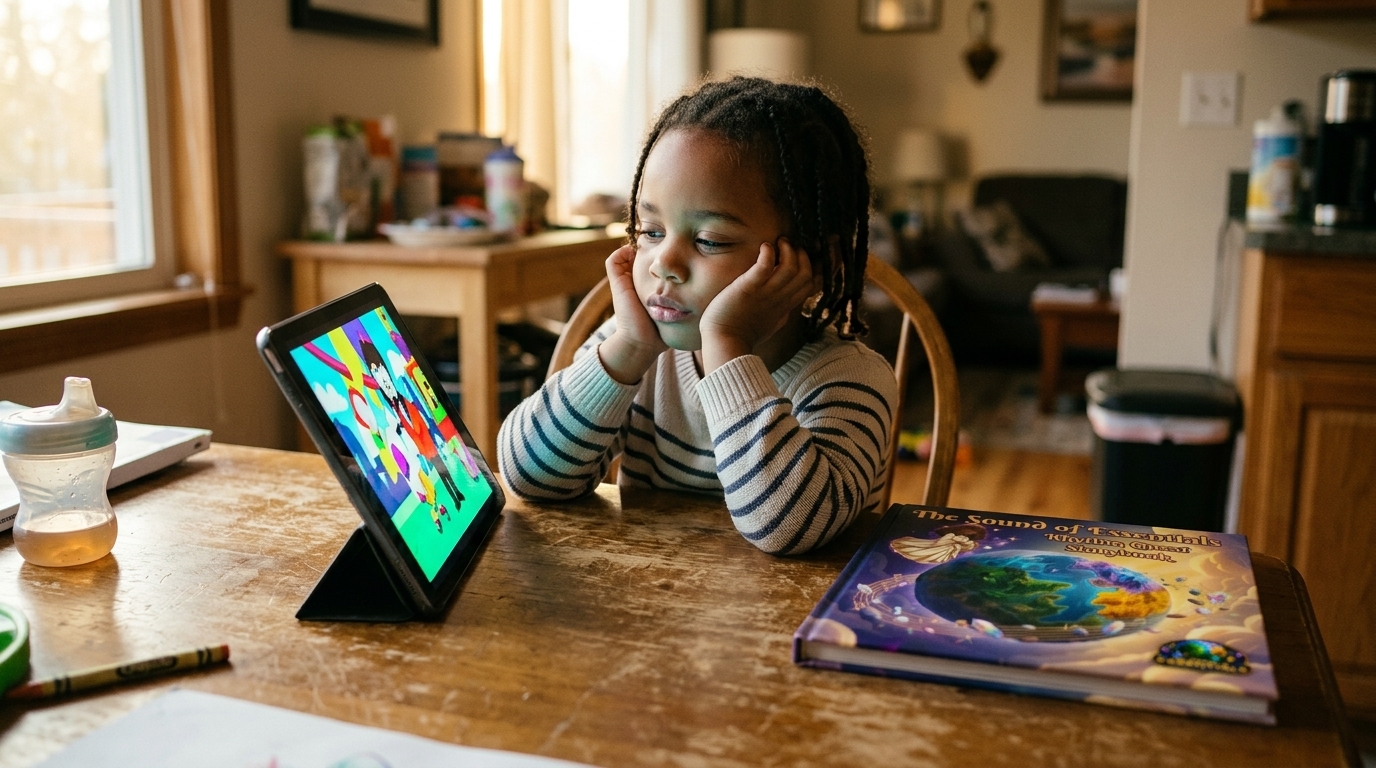
Parents everywhere invest money into top-rated language subscriptions hoping their children will pick up conversational English. The colorful interfaces look productive. A child drags an apple into a basket, hears a prerecorded chime, and advances to level four.
In reality, most gamified apps reward visual pattern matching and fast motor reflexes rather than vocal production. When a child taps the wrong picture, the screen simply rattles until they tap another one. They learn how to clear the interface to get the next reward, without ever forming an English phrase in their mouth.
Rapid animations, flashing scoreboards, and loud sound effects also keep developing nervous systems on high alert. Many children leave these sessions overstimulated and cranky. When an English speaker greets them on the playground, they freeze because they have only practiced tapping in silence.
The Second-Language Silence Trap: Why screen apps fail to build spoken English
There is a fundamental reason why children learning English as a second language go quiet on tablet apps: digital software trains the eyes to recognize shapes and fingers to tap buttons, completely bypassing the auditory cortex. But spoken English is a rhythm-driven, stress-timed acoustic language. When an app treats English like silent visual puzzles, a child's brain never connects meaning to speech production.
Linguistic research and developmental neuroscience reveal why traditional digital language apps leave global learners silent:
Spoken English begins in the ear long before the eyes decode print

When children struggle to speak English, parents worry their child lacks an ear for languages. That is rarely the case. The real obstacle lies in how English is structured.
English is a stress-timed language built on subtle rhythm, vowel reduction, and musical cadence. In contrast, languages such as Spanish, Japanese, or French follow more syllable-timed rhythms. To a young second-language learner, spoken English can sound like an unbroken blur of sound.
Between ages 2 and 7, the brain undergoes rapid auditory pruning. Children learn to parse words by hearing melodic contours, rising inflections, and distinct consonant stops. If their ears have never tuned into the rhythmic bounce of everyday English, showing them letterforms on a screen only leads to confusion.
A child needs to absorb speech rhythms through melody and physical movement first. Once the ear recognizes the cadence of a phrase, the tongue can imitate it, and the eyes can later connect it to print.
A music-first path across 7 story lands
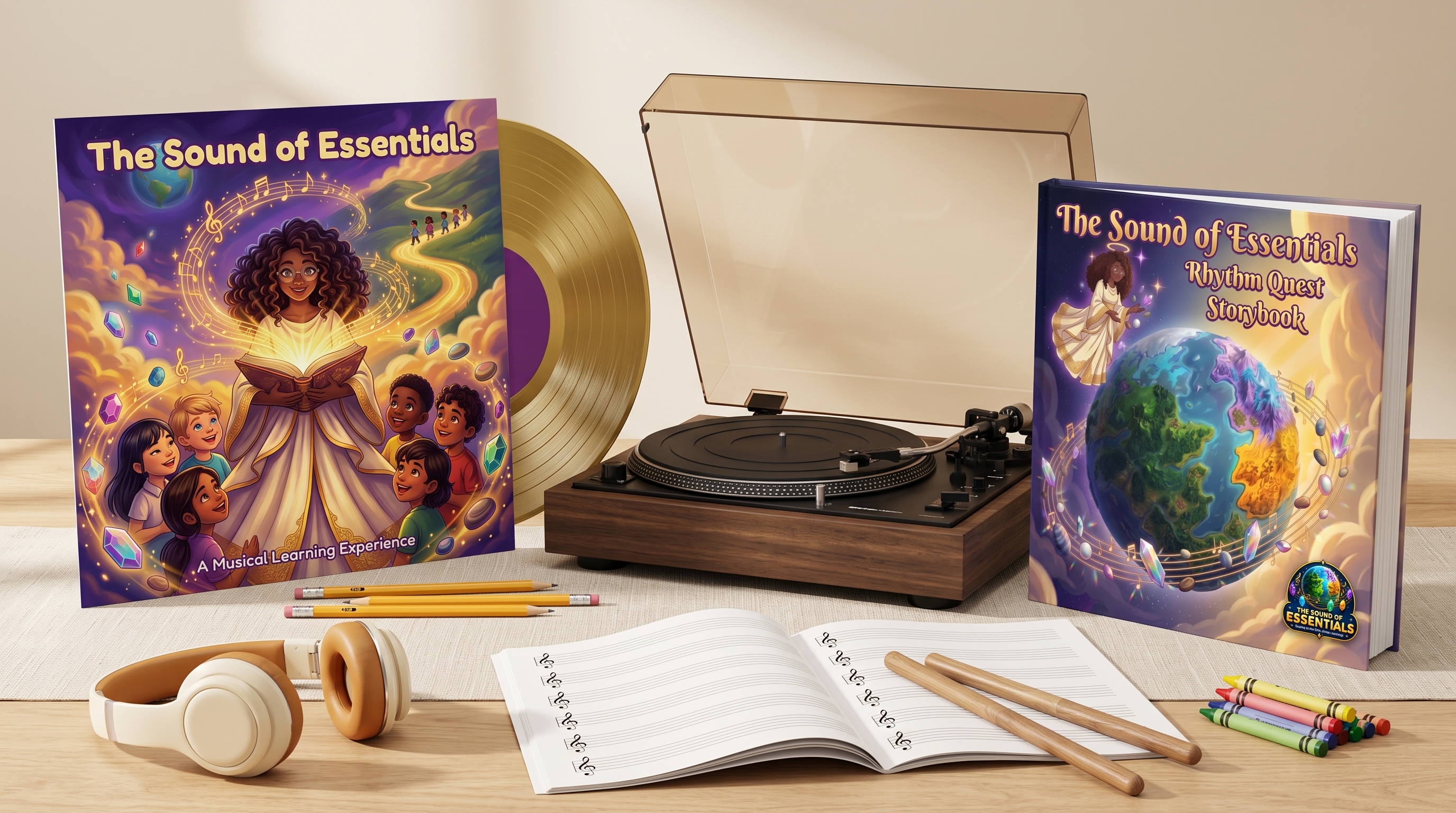
This foundational gap is why families across six continents are replacing screen-based language games with The Sound of Essentials: Rhythm Quest.
Created by educators and parents, the program sets aside addictive game mechanics, popup ads, and digital tracking. It centers entirely around 19 originally published acoustic tracks recorded live in studio sessions with warm, natural vocals.
Every song tells a story across 7 imaginative Lands, led by Seriphia and 15 friendly mentors. The music is deliberately arranged at 90 to 110 beats per minute, mirroring a child's resting heartbeat.
Instead of sitting alone with a tablet, children stand up, clap, stretch, and sing along to the lyrics. They learn days of the week, numbers, feelings, and everyday phrases while moving their bodies. By anchoring English to melody, children build spoken fluency naturally and stay on the path, always learning.
What this approach brings to your home
Families using The Sound of Essentials notice real shifts in how their children engage with English.
Everything inside the learning ecosystem
Designed specifically for early childhood (ages 2 to 7), blending audio storytelling with tactile materials.
5 Reasons families around the world rely on The Sound of Essentials
 1
The auditory window: Children absorb language through melody before print
Between ages 2 and 7, young brains build auditory networks at an extraordinary rate. For a child learning English as a second language, the ear must first learn to distinguish subtle vowel contrasts like "ship" and "sheep" or "cat" and "cut." The Sound of Essentials leads with acoustic song, training the ear before asking the child to read. This creates a solid auditory base that visual screens simply cannot provide.
 2
7 Story Lands replace disconnected flashcards with narrative meaning
Standard language apps present vocabulary in isolation: a dog on a white card, followed by an umbrella. Memory works far better when words belong to a story. In Rhythm Quest, vocabulary lives inside 7 distinct lands and 15 mentor characters. Children travel through Harmonia with Aiko and Kenji, count in Numeria, and explore nature in Vitalis. Words become part of an ongoing adventure rather than disconnected test questions.
 3
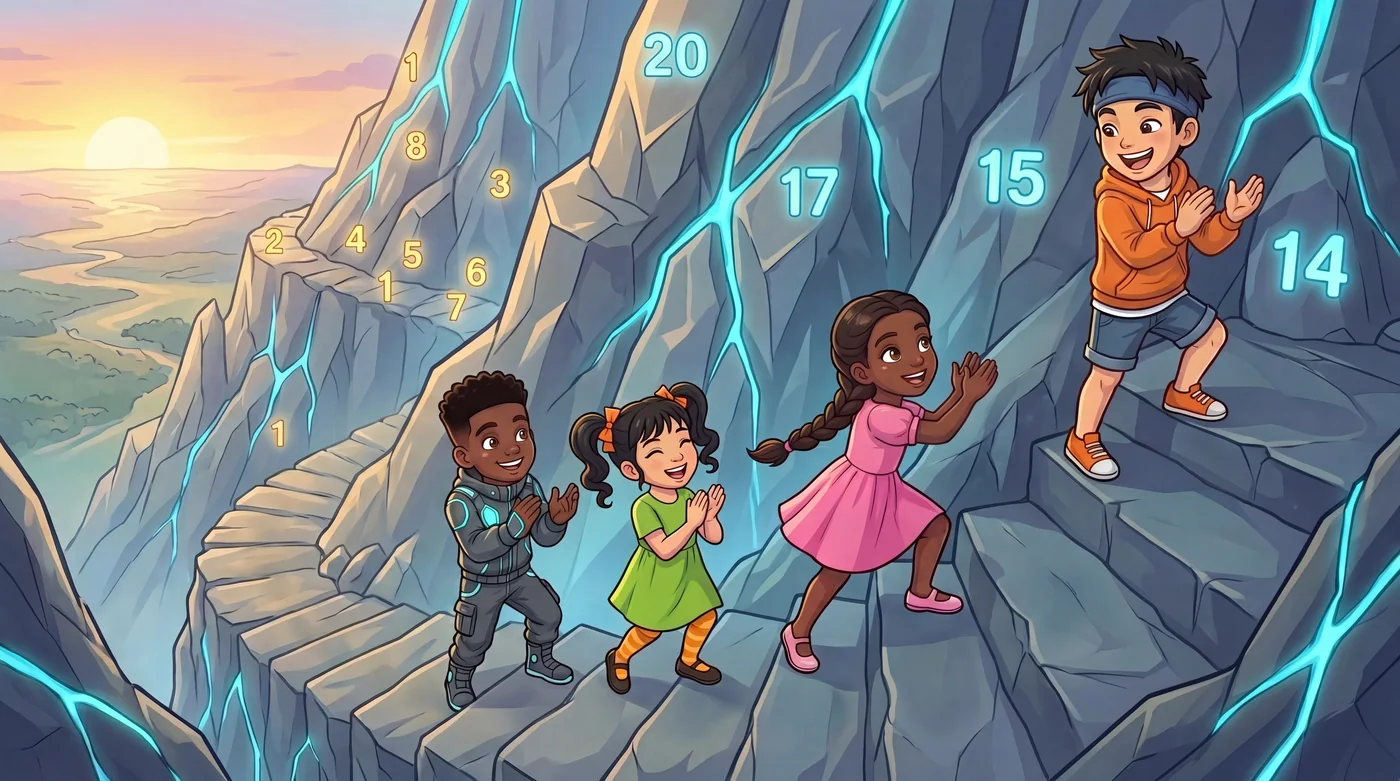
Whole-body rhythm removes the fear of speaking
Many children learning a second language freeze when asked to repeat words in front of an adult. Rhythm changes the dynamic. When children clap, jump, and sing to tracks like "Let's Stretch" or "Drill Time," their focus shifts to the game. They repeat full phrases without self-consciousness, building vocal muscle memory through everyday play.
 4
Gentle acoustic tempos keep children calm and attentive
Flashy language apps rely on rapid chimes, bouncing animations, and countdown timers to hold attention. That intensity often leaves young children wired and easily frustrated. The Sound of Essentials uses acoustic guitars, upright pianos, gentle percussion, and natural human voices. Children finish listening feeling calm, focused, and ready for conversation.
 5
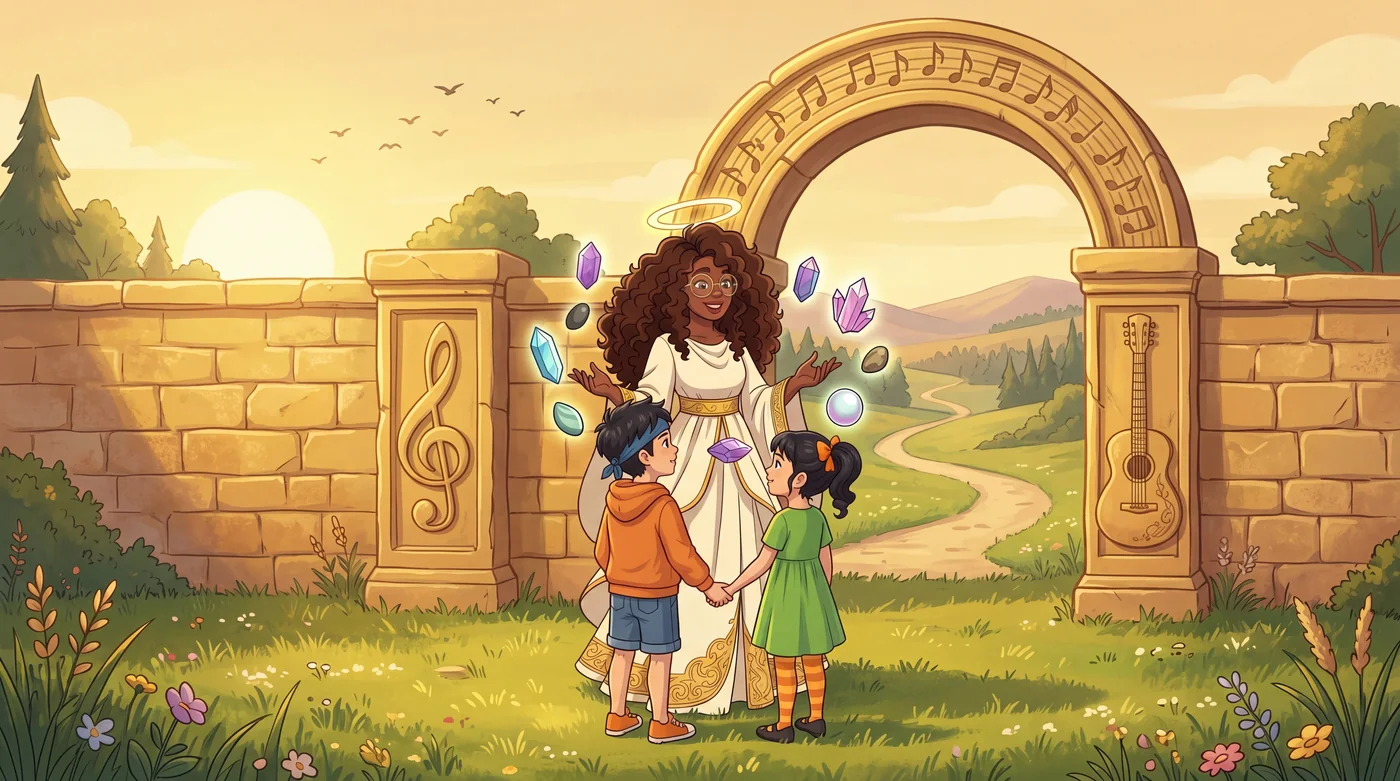
Staying on the path, always learning: A healthy posture toward growth
Learning a second language takes time, patience, and steady exposure. Guided by Seriphia, Rhythm Quest teaches children that trying a new word is an adventure, even when they make a mistake. They develop curiosity and genuine pride in speaking English, giving them a foundation that lasts well beyond early childhood.
What you can expect in the first few months
Children absorb language steadily when music leads the way.
Comparing standard language apps with The Sound of Essentials
Both aim to help children learn English, but their methods produce very different results in early childhood.
- Autoplay screens keep children staring silently in passive loops
- Treats English like Chinese characters by drilling visual word shapes, causing shape confusion (bunt / hunt / hurt)
- Forces letter drills and guessing before the ear recognizes discrete sound patterns
- Synthetic voices lack the natural warmth and inflection of real speech
- Timers and point systems often trigger frustration and meltdowns
- Tapping buttons builds motor reflex without encouraging spoken words
- Traps children in silent recognition loops without developing spontaneous spoken fluency
- Screen-free listening that parents control from any speaker
- Acoustic phonemic awareness: trains the ear to string individual sounds through song
- Eliminates visual shape confusion by unlocking the internal phonetic structure of words
- Warm acoustic arrangements recorded live with clear, warm vocal articulation
- Unhurried musical tempos support focus and emotional balance
- Clapping and dance routines encourage spontaneous spoken English
- Zero advertisements, zero behavioral tracking, and zero in-app gimmicks
Begin Your Child's English Journey Free Today
Frequently Asked Questions
Helpful details for families raising bilingual and second-language learners.
Support your child on their English journey today
Give your child the gift of spoken English through calm melody, memorable stories, and joyful daily rhythm. Free from screens, ads, and digital pressure.
Claim Your Free Deluxe Album Access →- Hirsh-Pasek, K., Zosh, J. M., Golinkoff, R. M., et al. (2015). "Putting Education in 'Educational' Apps: Lessons From the Science of Learning." Psychological Science in the Public Interest, 16(1), 3–34; and Meyer, M., et al. (2021). "How educational are 'educational' apps for children? An analysis of early childhood commercial learning applications." Journal of Children and Media, 15(4), 567–588. (Auditing 150+ commercial early language apps; finding over 84% rely on passive visual closed-loop matching without requiring expressive oral production).
- Kuhl, P. K. (2010). "Brain Mechanisms in Early Language Acquisition." Neuron, 67(5), 713–727; and Center on the Developing Child at Harvard University (2007). "The Science of Early Childhood Development: Closing the Gap Between What We Know and What We Do." (Establishing that phonetic discrimination, auditory pruning, and non-native stress-timing neural commitment peak between ages 2 and 7 before synaptic consolidation).
- Horwitz, E. K., Horwitz, M. B., & Cope, J. (1986). "Foreign Language Classroom Anxiety." The Modern Language Journal, 70(2), 125–132; and MacIntyre, P. D., & Gardner, R. C. (1994). "The subtle effects of language anxiety on cognitive processing in the second language." Language Learning, 44(2), 283–305. (Demonstrating that up to 74% of early second-language learners experience speech freezing, performance anxiety, and elevated affective filters when prompted to speak aloud from visual memory without acoustic scaffolding).
- Schön, D., Boyer, M., Moreno, S., Besson, M., Peretz, I., & Kolinsky, R. (2008). "Songs as an aid for language acquisition." Cognition, 106(2), 975–983; and Kraus, N., & Chandrasekaran, B. (2010). "Music training for the development of auditory skills." Nature Reviews Neuroscience, 11(8), 599–605. (Demonstrating up to a 3-fold acceleration in phonological boundary detection, syllable parsing, and conversational phrase recall when second-language input is anchored to melodic contour and rhythmic cadence).
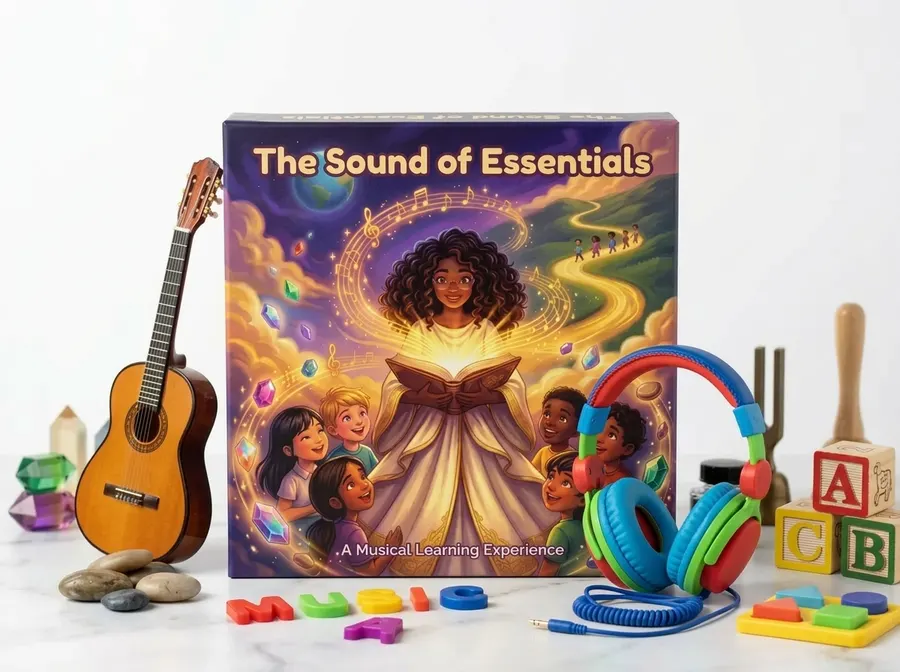
- ✓ 19 Master Acoustic Songs
- ✓ 7 Story Lands & 15 Mentors
- ✓ Printable 40-Page Companion
- ✓ 100% Screen-Free & Ad-Free